
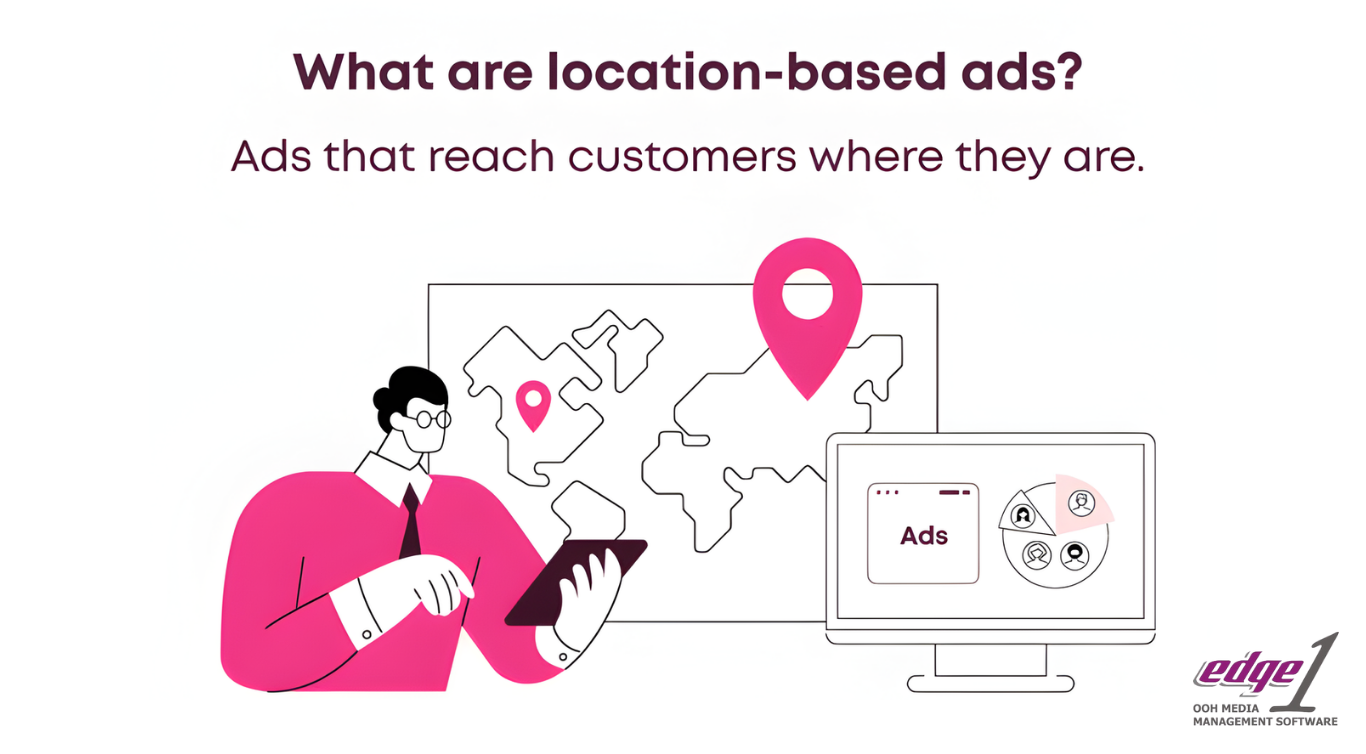
In today’s fragmented media landscape, Location-Based Advertising (LBA) is emerging as one of the most powerful tools for brands looking to drive real-world outcomes. As OOH advertising evolves into a data-driven medium, the ability to target audiences based on real-time location intelligence is transforming how campaigns are planned, executed, and measured.
What is Location-Based Advertising?
Location-Based Advertising leverages geographic data to deliver targeted messages to consumers based on their physical location. Whether through mobile devices, digital screens, or programmatic out-of-home (OOH) networks, LBA ensures that advertising is not just seen, but contextually experienced.
And it’s not a niche trend anymore.
- The global LBA market is projected to grow from $174.4 billion in 2026 to $579.7 billion by 2034, at a 16.2% CAGR
- Earlier estimates already showed strong momentum, with the market expected to cross $296 billion by 2030
This growth is being driven by one simple shift: advertising is becoming real-time and location-aware.
Why Location is the Most Powerful Signal
Unlike demographics or browsing history, location reflects intent in real time.
- A consumer near a mall is more likely to shop
- A commuter in traffic is more receptive to brand recall messaging
- A traveler at an airport is open to premium experiences
Location transforms advertising from interruption to interaction.
As Upinder Singh, CEO of Edge1, puts it:
“Advertising has traditionally optimized for reach because it was the easiest metric to measure. But reach without context creates waste. Location changes that equation, it introduces intent. When you understand where a consumer is, you begin to understand what they are likely to do next. The future of OOH lies in moving from measuring exposure to predicting behavior and location is the foundation that makes that possible.”
The Evolution of OOH into a Smart, Data-Driven Medium
Out-of-home advertising is no longer just about visibility, it’s becoming measurable, dynamic, and intelligent.
- Global OOH ad spend is expected to reach $49.8 billion in 2025
- The market has consistently stayed in the $40–45 billion range globally, showing long-term resilience
- Digital OOH (DOOH) is growing significantly faster, at 7.6% CAGR, compared to just 0.7% for traditional formats
- DOOH already accounts for 30–35% of total OOH spend and is rising rapidly
Even more telling:
- 68% of advertisers have increased investment in digital OOH to improve real-time engagement
This shift highlights a clear direction, OOH is becoming a performance-driven, data-powered medium.
How Edge1 Powers Location Intelligence in OOH
Platforms like Edge1 are accelerating this transformation by acting as the intelligence layer for OOH media.
Edge1 integrates location data, inventory, and analytics into one unified system, enabling:
1. Hyper-Local Campaign Targeting
Campaigns can be activated based on zones, proximity triggers, and real-world movement patterns, aligning with the industry’s shift toward geofencing and real-time targeting
2. Dynamic Content Delivery
With DOOH growing rapidly, advertisers can now adapt creatives in real time based on contextual signals like traffic, time, and audience density.
3. Data-Backed Planning
Modern OOH is powered by mobile location data, collected from billions of devices, allowing advertisers to make evidence-based decisions instead of assumptions
4. Measurable Outcomes
From footfall attribution to engagement tracking, campaigns move beyond impressions to real-world impact metrics.
Real-World Use Cases
Location-Based Advertising is already driving measurable outcomes across industries:
- Retail: Proximity targeting increases store visit likelihood
- Automotive: Transit OOH alone is growing at ~8.9% YoY, reflecting commuter engagement
- FMCG: Campaigns near retail distribution points improve conversion efficiency
- Real Estate: Hyper-local targeting improves lead quality
The common thread? Relevance leads to action, and data proves it
The Competitive Advantage of Being Context-Aware
Brands adopting location intelligence are seeing:
- Higher engagement rates
- Better ROI on media spends
- Stronger brand recall
- Increased conversion likelihood
Meanwhile, generic messaging is rapidly losing effectiveness in a world where consumers expect personalization in real time.
The Road Ahead: A $500+ Billion Opportunity
The convergence of:
- Mobile data
- AI-driven analytics
- Digital infrastructure
- Smart city ecosystems
…is shaping a future where advertising is seamlessly embedded into the consumer journey.
With the LBA market expected to cross $579 billion by 2034 , this is not just an evolution, it’s a fundamental shift in how media works.
As Babalpreet Kaur, Head of Sales at Edge1 adds:
“We’ve been thinking about location all wrong. It’s not just a targeting parameter, it’s a reflection of human behavior in motion. Every street, signal, and space carries intent. A crowded junction isn’t just high traffic, it’s impatience, distraction, and decision-making. A premium high street isn’t just affluence, it’s aspiration. The real opportunity in OOH is not selling space, it’s understanding what that space means to the consumer in that moment.”
Final Thought
Location is no longer just a coordinate, it is a signal of intent, behavior, and opportunity.
Platforms like Edge1 are unlocking this signal, enabling brands and media owners to move from broadcasting messages to orchestrating experiences.
If you’re a media owner, brand, or operator thinking about the future of location-driven advertising, join the dialogue with Edge1 and be part of what’s next.