
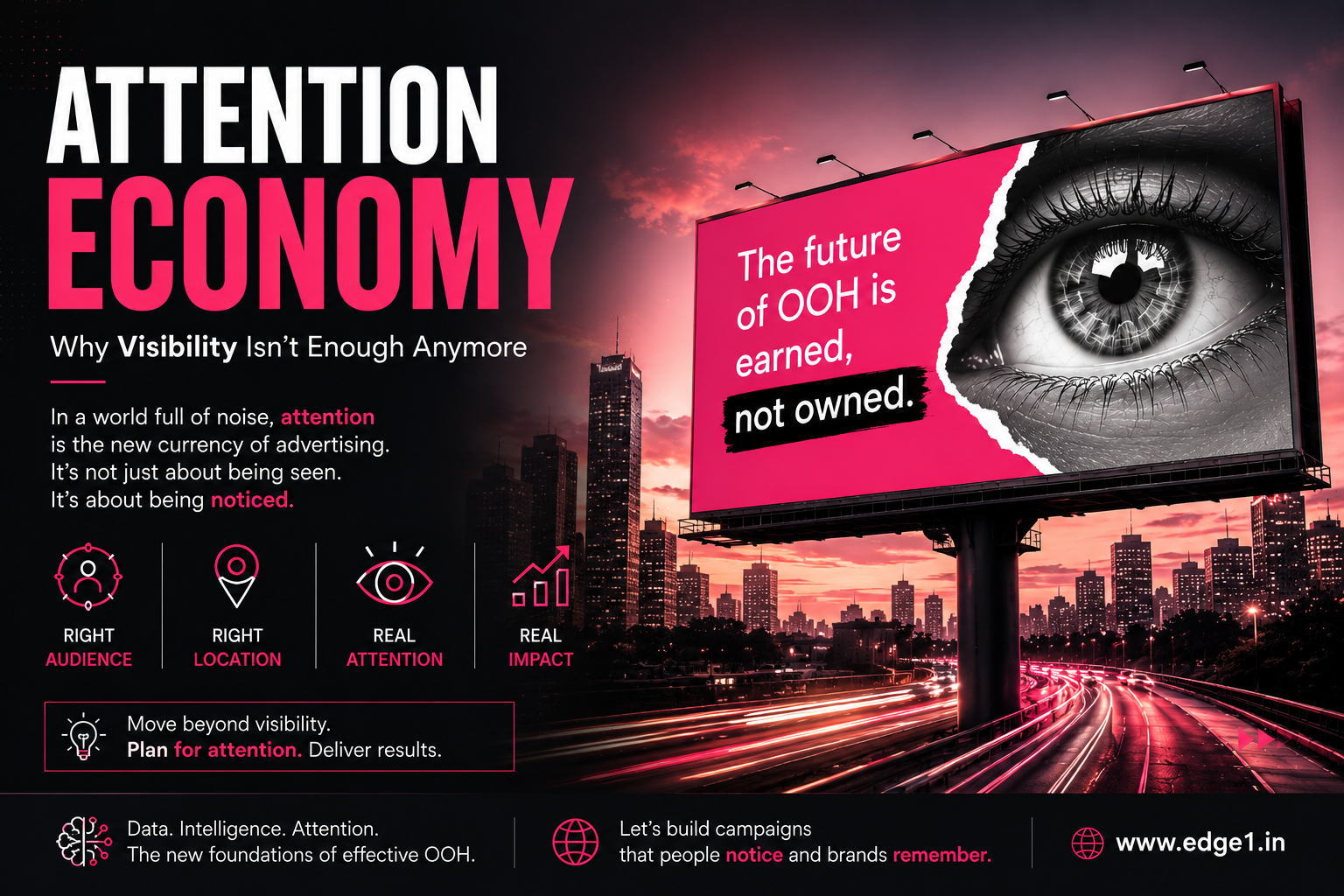
Why Visibility Isn’t Enough Anymore: The Future of OOH Advertising Lies in Attention, Audience Intelligence, and AI
For decades, success in Out-of-Home (OOH) advertising was measured using one simple metric: visibility.
If a billboard stood on a busy highway, overlooked a major intersection, or dominated a city’s skyline, it was automatically considered valuable. High traffic volumes translated into higher prices, and impressions became the industry’s primary currency.
But advertising has evolved.
Brands today are investing millions in marketing channels that provide measurable performance, audience insights, and campaign optimization. As digital platforms offer increasingly sophisticated analytics, expectations from OOH advertising have changed dramatically.
The question is no longer:
“Can people see my advertisement?”
The question is now:
“Is my advertisement capturing attention, reaching the right audience, and influencing real business outcomes?”
This shift marks one of the biggest transformations in the history of outdoor advertising.
The Era of Visibility
Traditional OOH planning focused on three major factors:
- Traffic volume
- Location prestige
- Estimated impressions
These metrics worked because data was limited.
A billboard located on a highway with 500,000 daily vehicles was naturally considered more valuable than one located on a quieter street.
However, this approach assumes that every passing person has equal value.
In reality, they don’t.
Not every viewer is a potential customer.
Not every impression is remembered.
Not every visible advertisement creates engagement.
Visibility alone cannot explain campaign success.
Why Impressions No Longer Tell the Whole Story
Imagine two billboards.
Billboard A
- 1 million monthly impressions
- Heavy traffic
- Vehicles moving at high speed
- Generic audience
- Average dwell time: 2–3 seconds
Billboard B
- 450,000 monthly impressions
- Near premium retail stores
- Slower-moving traffic
- Audience closely matches the target market
- Longer dwell time
- Better visibility angles
Which delivers better ROI?
Traditional planning would recommend Billboard A.
Modern advertising often favors Billboard B.
Because quality of attention frequently outweighs quantity of impressions.
The Rise of the Attention Economy
Attention has become one of the world’s most valuable resources.
Consumers encounter thousands of advertising messages every day across digital, television, retail, mobile, and outdoor channels.
Simply appearing in front of someone is no longer enough.
Successful advertising now competes for:
- Mental availability
- Visual engagement
- Memory
- Brand recall
- Purchase intent
OOH is uniquely positioned because it exists in the physical world.
Unlike digital ads that can be skipped or blocked, outdoor advertising naturally integrates into everyday journeys.
However, success depends on capturing meaningful attention not just occupying physical space.
What Modern Advertisers Actually Want
Today’s brands expect OOH campaigns to answer questions such as:
- Which audience segments viewed my campaign?
- What was the average dwell time?
- Which locations generated the highest engagement?
- Which sites delivered the strongest business impact?
- Can campaigns be optimized while they are still running?
- Which inventory should be selected based on campaign objectives rather than availability?
These expectations require far more than traditional traffic counts.
They require intelligent data.
From Static Planning to Intelligent Planning
Technology is transforming every stage of outdoor advertising.
Instead of manually reviewing hundreds of media locations, planners can now evaluate inventory using:
- Audience demographics
- Mobility patterns
- Consumer movement
- Location intelligence
- Historical performance
- Geographic relevance
- AI-driven recommendations
The result is better planning decisions with greater confidence.
AI Is Changing How OOH Campaigns Are Planned
Artificial Intelligence is no longer a futuristic concept.
It is becoming an essential decision-making assistant for agencies, brands, and media owners.
AI can help answer questions such as:
- Which locations should be selected based on campaign objectives?
- What inventory combinations maximize reach without increasing budget?
- Which sites overlap with competitors?
- Which audience segments are underserved?
- How can campaigns improve while live?
Rather than replacing media planners, AI enables them to make faster, smarter, and more informed decisions.
Why Media Owners Must Adapt
Media owners have traditionally competed on location and pricing.
Tomorrow’s competitive advantage will come from:
- Rich inventory data
- Live availability
- Audience insights
- Digital workflows
- Faster response times
- Campaign analytics
- Technology integration
Brands increasingly expect transparency and measurable value.
Media owners who invest in digital transformation will become preferred partners in a data-driven advertising ecosystem.
The Evolution of OOH Measurement
The industry’s measurement framework is expanding beyond impressions.
Modern success indicators include:
Attention
How likely people are to notice the advertisement.
Dwell Time
How long audiences remain exposed to the creative.
Audience Quality
Whether viewers belong to the campaign’s intended demographic.
Context
How relevant the location is to consumer intent.
Brand Recall
Whether the advertisement creates lasting memory.
Business Outcomes
Store visits, inquiries, website traffic, app downloads, and sales uplift.
Together, these metrics provide a much richer picture of campaign effectiveness than visibility alone.
The Future of Outdoor Advertising
OOH is becoming a connected ecosystem where inventory, planning, booking, execution, measurement, and optimization work together.
Future-ready platforms are expected to combine:
- Inventory management
- AI-powered planning
- Audience intelligence
- Real-time availability
- Campaign automation
- Performance dashboards
- Programmatic capabilities
This evolution allows brands to make evidence-based decisions while giving media owners greater visibility into inventory utilization and revenue opportunities.
Visibility Starts the Conversation. Attention Drives Results.
Visibility will always matter.
Without visibility, there is no opportunity for attention.
But visibility alone is no longer a competitive advantage.
Winning campaigns are built on understanding people not just places.
As the OOH industry embraces data, AI, audience measurement, and intelligent planning, success will increasingly be defined by attention, relevance, and measurable outcomes rather than raw exposure.
The future belongs to those who move beyond asking:
“How many people passed the billboard?”
and begin asking:
“How many of the right people noticed it, remembered it, and acted on it?”
That is where the next generation of outdoor advertising begins.
Key Takeaways
- Visibility is necessary, but it is no longer enough.
- Attention is emerging as a more meaningful performance metric than impressions alone.
- Audience intelligence enables better media planning and stronger ROI.
- AI is helping agencies and brands make faster, data-driven planning decisions.
- Media owners that embrace technology, transparency, and measurement will be better positioned for future growth.
- The future of OOH advertising lies in combining visibility with attention, relevance, and measurable business outcomes.